English
 русский
When someone asks what does a well head look like, the clearest answer is this: a wellhead typically appears as a compact, heavy-duty steel assembly of valves, flanges, and gauges rising vertically from the ground or a platform. Its upper section often resembles a tree with branches—hence the industry nickname “Christmas tree”—while the lower portion is a series of thick, bolted casing and tubing heads. This article breaks down the exact visual elements, dimensions, color markings, and field variations of a wellhead, giving you a comprehensive mental image of this critical oilfield equipment.
Content
- What Does a Well Head Look Like? – Core Visual Characteristics
- Key Components and Their Appearance
- Surface Wellhead vs. Subsea Wellhead – Visual Comparison
- Pressure Rating and Its Impact on Wellhead Appearance
- Color Codes and Markings on a Wellhead
- How the Wellhead Appearance Changes from Drilling to Production
- Wellhead Dimensions and Weight – Typical Numbers
- Frequently Asked Questions About Wellhead Appearance
What Does a Well Head Look Like? – Core Visual Characteristics
The most recognizable feature of a wellhead is its vertical, branched valve arrangement that sits directly above the wellbore. From a distance, an onshore wellhead looks like a sturdy metal post with multiple horizontal extensions, crowned by a network of wheel-shaped handwheels, pressure gauges, and pipe outlets. The overall height of a fully assembled production wellhead, including the Christmas tree, typically ranges from 8 to 14 feet (2.4–4.3 meters), while the width at the valve sections can reach 4 to 6 feet (1.2–1.8 meters). The structure is almost exclusively made of forged or cast alloy steel, designed to withstand pressures from 5,000 psi up to 20,000 psi (per API 6A specifications). The surface is coated with corrosion-resistant paint, frequently in industrial yellow, red, or green, which makes the wellhead stand out clearly against the surrounding terrain or offshore platform deck. Every connection point features heavy flanges with large, evenly spaced stud bolts, giving the entire assembly a robust, industrial silhouette.
Key Components and Their Appearance
Each visible part of a wellhead serves a distinct function and presents a distinct industrial shape, and recognizing these components immediately answers the question of what does a well head look like at a granular level.
Casing Head
The casing head is the lowermost visible part. It looks like a heavy, thick-walled cylindrical bowl with flanged top and bottom connections. Its side often features one or two outlets—called side outlets or choke/kill line connections—which are short, stubby flanged pipes extending horizontally. In many designs, the casing head houses the casing hanger inside, but externally you see a robust, often slightly wider base that anchors the entire wellhead to the conductor pipe.
Tubing Head
Stacked directly above the casing head, the tubing head supports the tubing string and provides an additional outlet. Visually, it is similar to the casing head but may have a slightly smaller outer diameter and a more pronounced top flange. The tubing head adapter and locking bolts are often visible as a ring of smaller screw-type components just below the Christmas tree. This section creates the transition from the straight cylindrical wellhead body to the branched upper valve assembly.
Christmas Tree (Upper Valve Assembly)
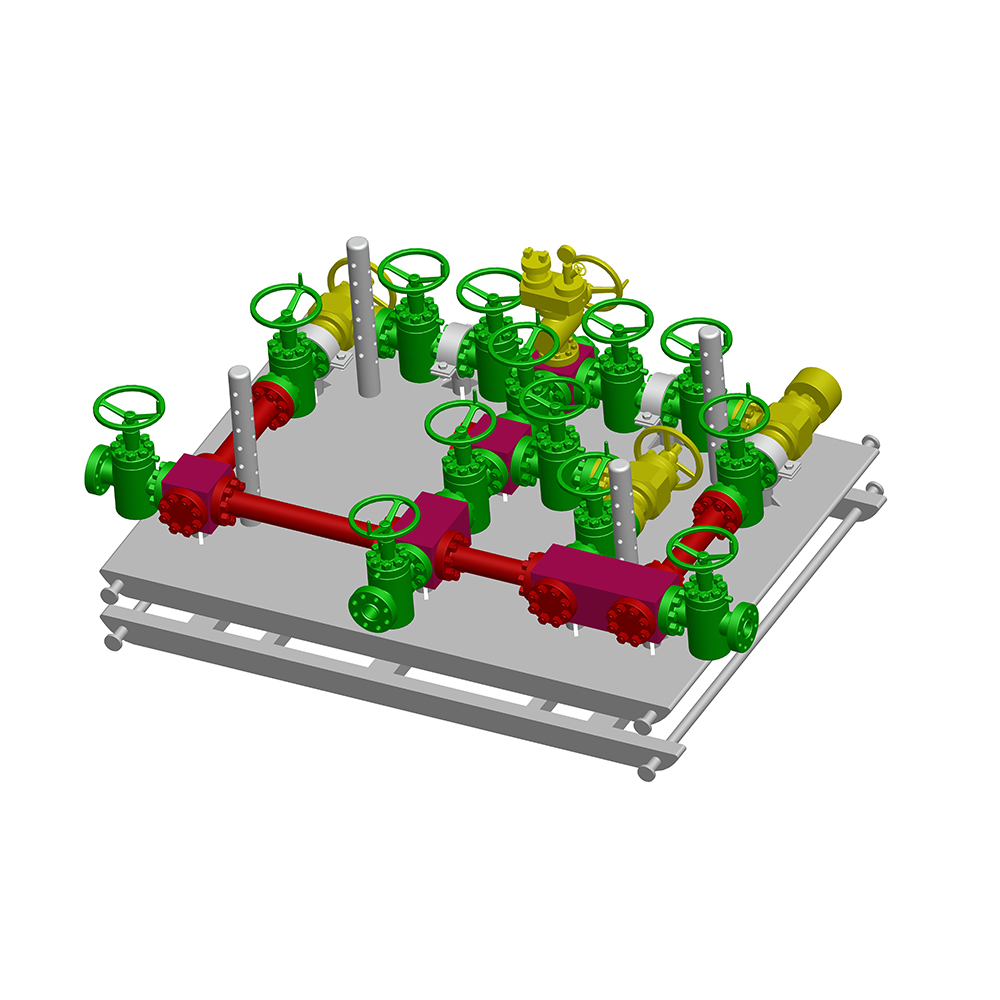
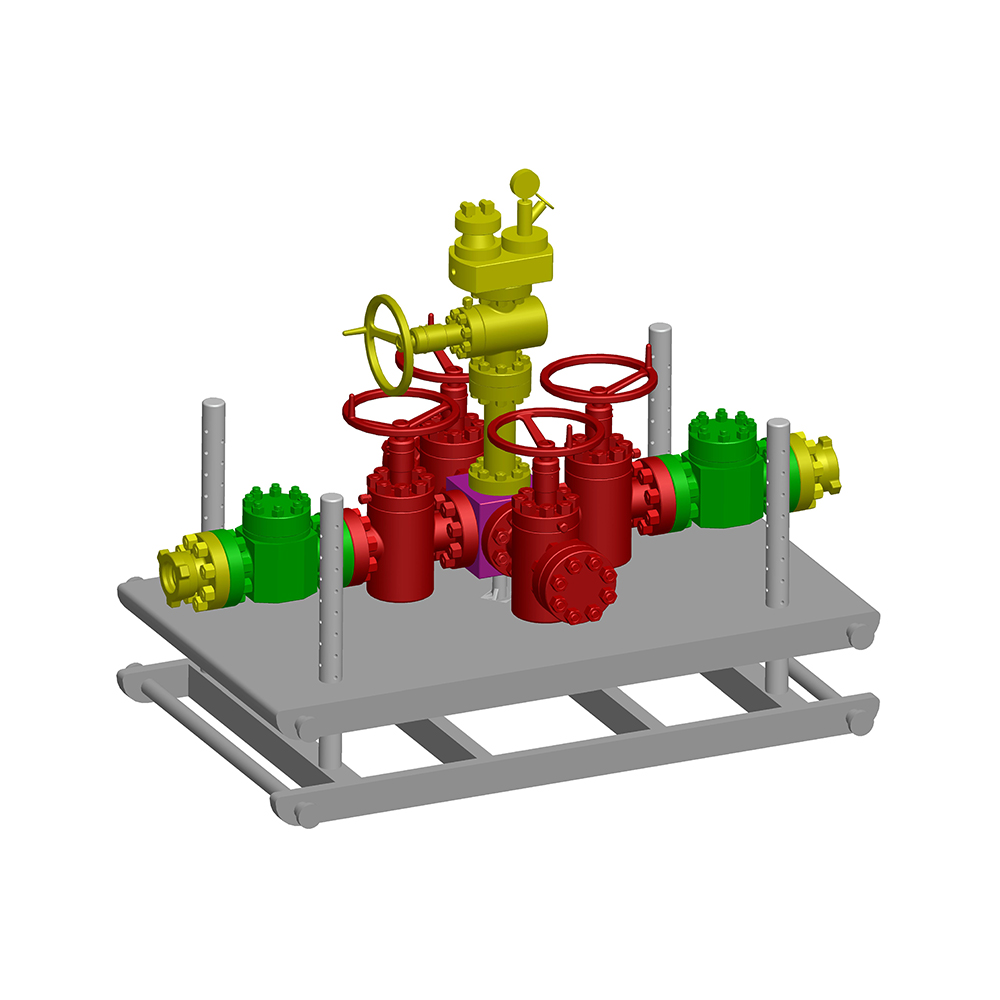
The Christmas tree is the most visually distinctive part. It consists of multiple gate valves arranged in a vertical and horizontal configuration. A typical tree has a master valve (the large valve directly on top of the tubing head), two wing valves branching to the sides, and a swab valve on the very top, often with a small pressure gauge mounted on it. From a front view, the wing valves extend left and right, creating the characteristic “tree” shape. Each valve is operated by a large, round handwheel or a T-bar handle, giving the assembly a mechanical, almost locomotive-like appearance. The tree may also include a choke valve, identifiable by its more elongated, conical body and a graduated adjustment wheel.
Pressure Gauges and Instrumentation
Small circular pressure gauges with white or black faces are typically mounted on the wing valves or directly on the tree body. Their metallic cases are often stainless steel and add to the technical, instrumented appearance of the wellhead. Digital transmitters are occasionally seen, encased in rectangular, weatherproof housings attached to the side of the tree.
Surface Wellhead vs. Subsea Wellhead – Visual Comparison
Onshore wellheads stand tall and exposed, whereas subsea wellheads appear as compact, highly protected frames sitting on the seabed. The environment fundamentally changes the visual profile. A land wellhead is a vertical, tree-shaped structure that an operator can walk around; a subsea wellhead, viewed by ROV cameras, looks like a low, open-framed steel box with horizontal valve blocks, almost entirely painted in high-visibility yellow.
| Visual Feature | Onshore / Land Wellhead | Subsea Wellhead |
|---|---|---|
| Overall shape | Vertical tree with extended lateral valves | Horizontal or compact vertical tree inside a protective frame |
| Height | 8–14 ft (2.4–4.3 m) | 10–20 ft (3–6 m) including guide frame, but low profile |
| Visibility of valves | Fully exposed handwheels and stems | Valves are enclosed; only ROV torque buckets visible |
| Color | Often yellow, red, or green | Predominantly high-visibility yellow |
| Protective structure | None, or simple concrete base | Large steel guide base and debris cap |
Pressure Rating and Its Impact on Wellhead Appearance
Higher pressure-rated wellheads have noticeably thicker flanges, larger bolt diameters, and bulkier valve bodies. API 6A defines pressure ratings from 2,000 psi to 20,000 psi, and the physical dimensions scale proportionally. As the pressure class increases, the outer diameter of flanges grows, and the number of stud bolts increases, giving the wellhead a visibly more massive and imposing appearance. An operator can often estimate the pressure rating just by looking at flange thickness and bolt size.
| API 6A Pressure Rating | Typical Flange OD (13-5/8 in bore) | Bolt Count & Size | Visual Signature |
|---|---|---|---|
| 5,000 psi | ~28.5 in (724 mm) | 16 bolts, 1.5 in | Moderate flange, compact valves |
| 10,000 psi | ~34.5 in (876 mm) | 20 bolts, 1.75 in | Visibly thicker flanges, larger handwheels |
| 15,000 psi | ~41.0 in (1041 mm) | 24 bolts, 2.0 in | Oversized flanges, very robust body |
| 20,000 psi | ~46.0 in (1168 mm) | 24 bolts, 2.25 in | Monumental flanges, heaviest construction |
The difference is even more striking in the valve bodies. A 5,000 psi gate valve might have a body width of approximately 10 inches, while a 15,000 psi valve of the same bore can exceed 16 inches in width, with a distinctly bulkier actuator and handwheel diameter growing from 12 inches to over 20 inches. This scaling provides a quick visual cue for field personnel evaluating the wellhead's pressure class.
Color Codes and Markings on a Wellhead
Wellheads are painted in distinctive, safety-oriented colors, and they carry permanent metal identification plates that provide critical operational data. While color schemes can vary by operator and region, there are common patterns. In many North American onshore fields, the entire wellhead assembly is painted high-gloss yellow for high visibility. Offshore platforms often use yellow for the tree and red for high-pressure components. Some operators paint the Christmas tree green to indicate a producing well, while injection wellheads may be blue. According to API RP 500 and industry safety practices, these colors serve to alert personnel to hazard zones and to ease field identification during emergencies. The color is not just aesthetic—it is a functional visual identifier.
Additionally, every wellhead carries a nameplate, typically a rectangular stainless steel plate riveted or bolted to the casing head or tree. The plate is engraved with data such as manufacturer, serial number, pressure rating, temperature class, material class, and API monogram. This plate is usually silver-colored with black embossed text and is positioned so it can be read without disassembly. It provides a definitive way to identify what a well head looks like in terms of its engineering specification, not just its external shape.
How the Wellhead Appearance Changes from Drilling to Production
The wellhead visual profile evolves significantly during its lifecycle. During drilling, the image is dominated by a blowout preventer (BOP) stack—a towering, square or circular assembly of ram-type preventers and an annular preventer, often painted a stark red or blue, sitting on top of the casing head. The BOP can be 20 to 30 feet tall, completely obscuring the lower wellhead components. Once drilling is completed and the BOP is removed, the Christmas tree is installed. At that point, what does a well head look like shifts to the familiar branched valve configuration. For a workover operation, the tree may again be replaced by a smaller BOP or a workover riser, temporarily altering the appearance. So, the wellhead is not a static visual element; it transforms depending on the phase of well activity.
Wellhead Dimensions and Weight – Typical Numbers
A complete onshore production wellhead assembly, including casing head, tubing head, and Christmas tree, commonly weighs between 1,500 and 5,000 pounds (680–2,270 kg), depending on pressure rating and bore size. For a typical 10,000 psi, 3-1/16-inch bore tree, the Christmas tree section alone can weigh around 1,200 pounds. The height from the bottom flange of the casing head to the top of the swab valve is about 9 to 11 feet, while the total width at the wing valve extremities can span 5 to 6 feet. These numbers are derived from common API 6A equipment catalogs and field surveys presented in SPE papers such as SPE-199876-MS. Subsea trees are even heavier: a deepwater horizontal tree can weigh 30 to 50 tons, including the guide base, but this massive weight is largely submerged and hidden from direct view, only apparent in the size of the deployment frame on a vessel.
Frequently Asked Questions About Wellhead Appearance
What does a well head look like on a drilling rig?
On a drilling rig, the wellhead appears as a towering BOP stack—a series of large, rectangular or cylindrical steel blocks with flanged connections—mounted on top of the casing head. Only after drilling is the BOP removed and the Christmas tree installed, revealing the branched tree shape.
Why is part of the wellhead called a Christmas tree?
The upper valve assembly resembles a decorated tree, with the vertical stem acting as the trunk and the wing valves as branches. The handwheels and pressure gauges add to the festive visual similarity, a term that has been in use since the 1920s in oilfield slang.
Are all wellheads painted yellow?
Not always. Yellow is the most common high-visibility choice, but red, green, and blue are also used depending on operator standards and well function. The color does not affect the mechanical appearance, but it strongly influences the immediate visual impression.
How can I tell the pressure rating just by looking?
Look at the flange thickness and the size of the bolts. Higher-rated flanges are noticeably thicker and have more bolts of larger diameter. A 15,000 psi flange appears much more massive than a 5,000 psi flange of the same nominal bore size, as detailed in Table 2.
What is the difference between a wellhead and a Christmas tree?
The wellhead is the complete assembly from the casing head upward, including the tubing head and the Christmas tree. The Christmas tree is specifically the upper valve array. So, when people ask what does a well head look like, they are often picturing the entire stack, with the tree being the most eye-catching part.
From the heavy flanged base to the branched valve top, the wellhead presents a rugged, purposeful industrial design. By observing its silhouette, flange dimensions, color codes, and the presence or absence of a BOP, anyone can build an accurate mental picture of what a well head looks like across different environments and operational stages.